My Martha Stewart Era (And What the Mint Had to Say About It)
When I made the big decision to leave my career and step into full-time motherhood, I had no idea what I was signing on to. It was November. The days were long and gray, the nights were sleepless, and my sense of purpose had quietly drifted somewhere between diapers and being a human pantry. This was not what I had pictured.
But in those long hours alone during the day, I discovered Martha in a way that went beyond the cover of a magazine. And among the many personas I would eventually try on, none felt quite as promising as Master Gardener.
I dabbled at first. Then I went full throttle.
It was the era of Martha, and I do mean era. Martha wasn't just a lifestyle brand back then; she was a religion, and I was a devoted convert. If Martha could hot-glue pinecones into something worthy of a gallery wall, I could certainly grow things in the ground. How hard could it be? You put plants in dirt. The dirt does the rest. I had watched enough episodes to feel genuinely confident about this.
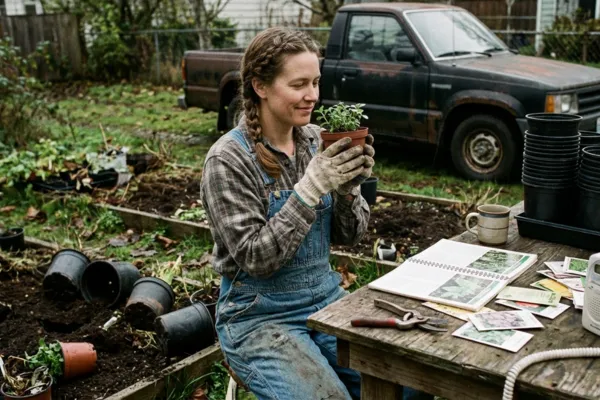
What I had was a ginormous yard in desperate need of attention, a garage full of tools, a wholesale nursery license, and one girlfriend, a former colleague from the Seattle Times, who had curated a beautiful urban garden and was thrilled at the prospect of buying wholesale. The two of us would head out to the nursery together in her beat-up little pickup, Sunset Plant Guides in hand, moving through those rows with the slow, deliberate focus of women on a mission.
This one. Definitely this one. Oh, and this. I have no idea what this is, but it's beautiful.
I planted roses I had personally researched and selected. I built raised beds. I dug up plants from places I had traveled and relocated them to the greenbelt in the backyard, which, in retrospect, is the kind of thing only someone with a lot of time and a strong sense of destiny does to a greenbelt. I worked that yard with a ferocity I now recognize as the energy of a woman trying to figure out who she is supposed to be, pouring herself somewhere tangible, somewhere she could see the results.
Here's what I didn't understand about the yard: the entire property sat on what can only be described as a slab of clay. Not really soil. Clay. The kind of ground that looks like earth but behaves like concrete with aspirations. Every hole I dug was an act of negotiation. I dreamed of bulldozing the whole thing and starting over with healthy soil, but that was a fantasy. So I just kept digging.
I learned a lot during that era. I learned that host as shrivel and die in direct sunlight. I learned that hundreds of bunnies lived in the woods behind my house and had very strong feelings about tulips, pansies, and marigolds, eating them straight down to the nub without a shred of remorse. I learned where the plants that mattered to me should and shouldn't be placed, a lesson I was not yet applying to other areas of my life.
I became something close to a mother to that garden. I worried over it. I tended it before I tended myself some mornings. I poured real love into it, particularly into one rose I'd spent an entire afternoon coaxing into that unforgiving clay ground.
And then I planted mint.
I planted it because I was also channeling my inner chef. That's a whole other story, but yes, Martha had opinions about fresh herbs, and so did I. Rosemary. Sage. Thyme. And mint.
What I did not know about mint, or failed to read about in the Sunset Guide, is that it needs to be contained. Mint sends roots underground, quietly and persistently, spreading in every direction without asking permission. I looked out one day and realized it had simply decided to take over.
I stood there looking at my garden, this thing I had built with my hands, this labor of love planted on top of a clay slab, and I thought: Oh. I know this feeling.
Because here's the thing about roots you can't see. They do their work whether you're watching or not. The stories we absorb from other people, what a wife should be, what a mother should look like, what a woman of a certain age is supposed to want, they don't announce themselves. They don't ask permission. They travel underground, through the quiet moments, through the comparisons and the expectations and the voice that sounds almost like yours but isn't quite. And one day you look up and realize those roots have gotten into places you never invited them.
The mint didn't ask if it could take over. It just did what it was designed to do in the absence of a boundary.
And I had been doing the same thing. Building something beautiful on top of a foundation that wasn't quite right, tending a vision that was partly mine and partly something I had absorbed from the world around me. Martha. The neighborhood. The idea of what this chapter of life was supposed to look like.
The clay was always there. I just kept working around it instead of asking whether the ground itself needed to change.
I eventually left that garden. The roses, the raised beds, the greenbelt I had so optimistically landscaped, all of it stayed behind. And I grieved it, the way you grieve something you poured yourself into, even when leaving was the right thing.
But the story of the mint stayed with me.
So I'll leave you with this, not as an answer, but as something to sit with:
What are you nurturing, and is the ground beneath it actually yours? Sometimes the most important question isn't what to plant next. It's whether the foundation was ever right.
Love and Light,
Michèle


