How Do I Start Over at 60 After Divorce?
You start over at 60 the same way anyone rebuilds well at any age, by getting clear on what you actually value now, not what you valued at 35, and then making small, deliberate moves in that direction rather than trying to reconstruct the life you had. Starting over at this age is not a consolation prize or a race against time. You are working with more self-knowledge, more freedom, and fewer people to ask permission of than at any earlier point in your life. The practical work is real, finances, housing, community, and it is all navigable with the right order of operations.
The reason this question feels unanswerable at 2 a.m. is that most women are asking a different question underneath it: is it too late for me? That question rests on a belief worth examining, the belief that reinvention has an age limit, that new lives are for the young, and that what remains after a long marriage ends is management rather than possibility. Nobody decided this belief on purpose. It arrived through culture and repetition, and it goes unexamined because questioning it feels presumptuous. So let me be plain, as someone who has rebuilt her life more than once, it is inherited fiction. The rise of divorce after 50, now a large and growing share of all divorces, exists precisely because so many people concluded that 20 or 30 more years was too long to live inside a life that no longer fit.
What Starting Over Actually Means at This Age
Starting over at 60 is not starting from zero. You are starting from six decades of evidence about what you love, what drains you, what you tolerate, and what you have been postponing. The women I work with through this transition are not blank pages. They are experienced, capable people whose lives were organized around roles, wife, mother, caretaker of everyone's logistics and feelings, and who now face the question those roles kept crowded out: what do I actually want?
In my VIVID³ framework, this is the territory of Values and Identity, and it is where reinvention either becomes real or stays a Pinterest board.
Your values at 60 are not your values at 35. Some of what drove the early decades, proving something, earning security, building a reputation, keeping a family running, has served its purpose. What remains after those motivations are satisfied is often truer, and more interesting. The first task is separating what you actually care about from what you were taught to care about.
Identity is the harder, better question. After decades of being counted on, the question is not only who do you want to become. It is what have you been performing, and for whom? There may be a version of you that has been waiting for her turn. Reinvention at 60 is largely the process of giving it to her.
The Steps: A 90-Day Way to Begin
Grand reinvention plans tend to collapse under their own weight. Small shifts create new direction. This is the structure I use with clients, and you can begin it this week.
Take inventory before you take action. Spend the first two weeks answering, in writing: Which of my current values feel chosen, and which arrived so long ago I stopped questioning them? What would I move toward if the standard definitions of success no longer applied? What do I already know, not suspect, but know, that I have not yet said out loud?
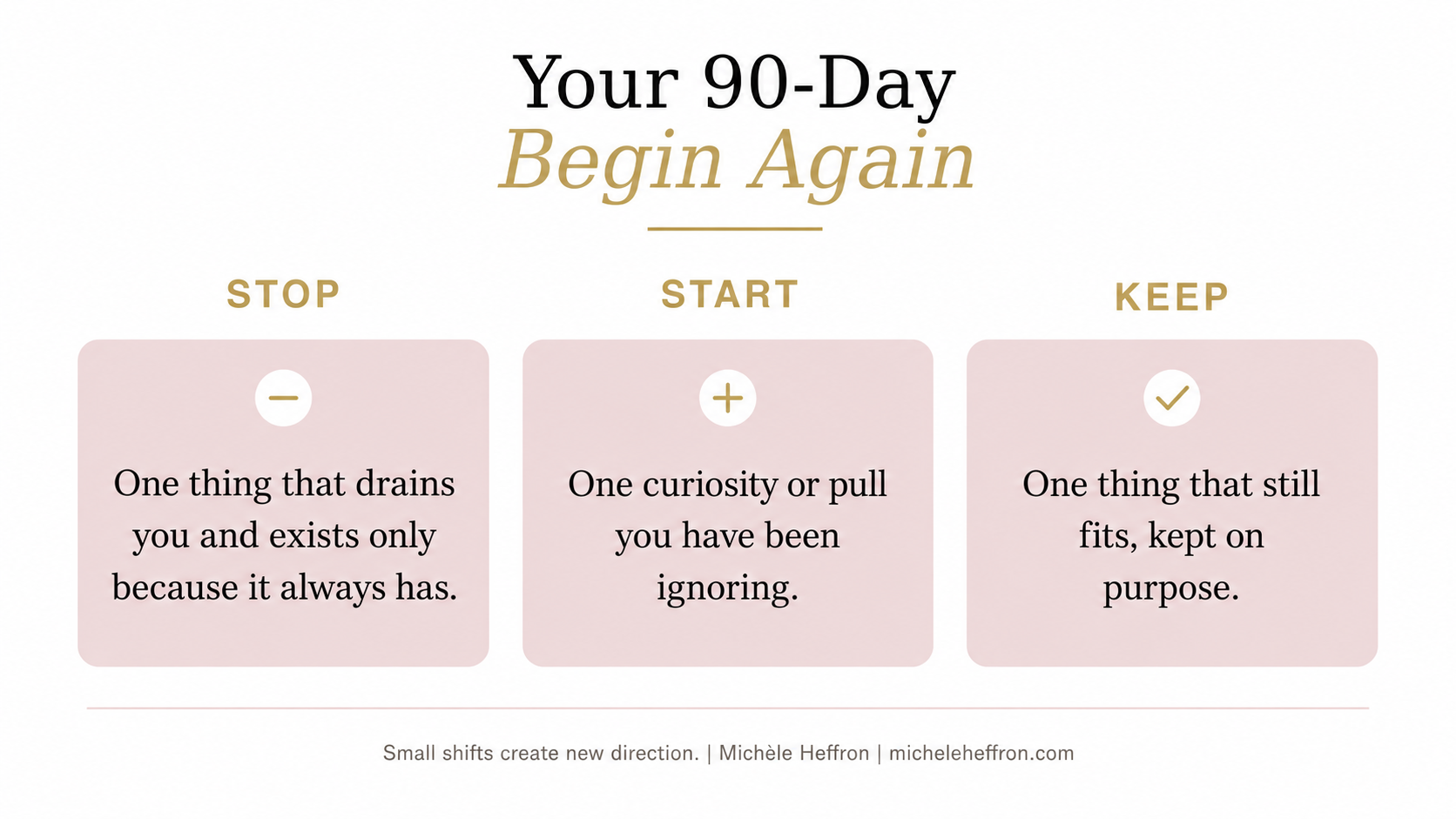
Choose one thing to stop. One commitment, habit, or obligation that drains you and exists mostly because it always has. Stopping something creates the room that starting something requires.
Choose one thing to start. One curiosity or pull you have been ignoring. Not a five-year plan. A class, a conversation, a trip, a volunteer role, a room of your own. The point is evidence, proof to yourself that the next chapter is being authored on purpose.
Choose one thing to keep. Reinvention is not demolition. Name what still fits and serves you, and keep it deliberately rather than by default.
Rebuild the practical foundation in the right order. Understand your post-divorce financial picture with a qualified financial professional before making major moves like selling or buying a home. Give new routines and community time to form. Expect the first year to feel unfamiliar. Unfamiliar is not wrong.
Get support that is actually about you. Friends and adult children love you, and they also have their own feelings about your divorce. A coach, or a group of women walking the same road, gives you a place where your next chapter is the only agenda item.
A Client Who Did This
One client came to this work after leaving a career of more than 30 years, around the same season her long marriage ended. The question of who she was without the two structures that had defined her for decades, her marriage and her career.. We worked through exactly the sequence above: values first, then identity, then small deliberate moves. She rebuilt on her own terms, and the life she built was not a reduced version of the old one. It was hers. [VERIFY details and timeframe before publishing.]
I will add my own evidence to the pile. I have navigated two divorces and rebuilt my life more than once, including a move from decades of nonprofit leadership into this work. What I teach, I have earned, and I would not trade this chapter for any of the earlier ones.
What Deserves Honest Caution
Starting over does not mean pretending the losses are not real. Grief for the marriage, the imagined future, and some friendships is legitimate work, and if it is heavier than daily life can hold, a therapist is the right support alongside any of this. And the financial realities of rebuilding after a long marriage deserve professional attention: retirement timelines, Social Security decisions, and housing choices at this stage have long consequences, and they belong with a financial advisor or CDFA, not a blog post.
Frequently Asked Questions
Is it too late to start over at 65? No. The practical questions change with age, finances and health planning deserve more care, but the capacity to build a life that fits is not age-limited. I have watched women in their 60s and 70s create lives they had postponed for decades.
How do I rebuild my life after divorce with no career? Start with an honest inventory of what decades of managing a home, family, and community actually built: organization, judgment, resilience, people skills. Then decide whether you need income, purpose, or both, because they lead to different next steps. A financial professional can clarify the income question so fear does not answer it for you.
How do I stop being afraid of being alone after divorce? By separating alone from lonely, and building the version of alone that is chosen: rituals, community, and a home that reflects you. For many women the deeper fear is not solitude. It is meeting themselves without the marriage as a buffer. That meeting tends to go better than feared, especially with support.
Will I ever find love again after 60? Love is available at every age, and the healthiest version of it tends to arrive after the identity work, not instead of it. Who you become determines what you attract. When calling in love is the specific goal, that is its own body of work, and it begins with you rather than with dating apps.
How long does it take to feel normal after a gray divorce? Most people find the first year is about logistics and stabilization, and the sense of a life that feels like their own builds over the second and third. Support compresses that timeline. Isolation extends it.
What should I do first after my divorce is final? Before any major irreversible decision, get financially oriented with a qualified professional, reestablish daily structure, and do the values inventory described above. Clarity first, then the big moves.
Key Takeaways
Starting over at 60 is not starting from zero. You bring six decades of self-knowledge and fewer people to ask permission of than ever before.
The belief that reinvention has an age limit is inherited, not true, and it is the main thing standing between most women and their next chapter.
Begin with values and identity, the first elements of the VIVID³ framework, before making major practical moves.
Use the stop, start, keep structure: one thing to release, one to begin, one to keep on purpose, within 90 days.
Financial decisions at this stage have long consequences. Bring in a financial professional early, and let clarity set the order.
A Tool You Can Use Today: The Three Question Filter
When something arrives from your spouse, an attorney, or the court, and your whole body wants to respond immediately, run it through these three questions first.
Is this true, or is this how it feels right now? Strong feelings are real. They are not always accurate reporting on what just happened.
Does this need a response today, or does it only feel that way? Almost nothing in this process actually requires an immediate reaction. Most things only feel urgent.
Will this response help my case, or will it help me feel better for ten minutes? Both matter. Only one of them is free.
Write the angry version if you need to. Then close the laptop. Come back to it later, or send it first to someone who is not inside the moment with you. This is not about suppressing what you feel. It is about not letting the feeling write the email.
What This Looks Like in Practice
One client found me through a Google search at a moment when she did not know where else to turn. She had been sleeping on the edge of her mattress for months, staying as far from her husband as she could without falling off. She knew something had to change. She did not know where to start, and she did not call an attorney first. She started with a conversation. The work we did was not only the process of her divorce. It was the question of who she was, what she actually wanted, and what it would look like to make decisions from that place rather than from fear. Eighteen months later, she described her life as moving from the edge of the mattress to the center of her own life. Her words.
Where Coaching Fits, and Where It Does Not
I am an ICF Certified Life, Relationship & Divorce Coach and a Certified Divorce Coach, and it matters to be precise about lanes. Coaching is forward-focused decision support. It is not therapy: if grief, trauma, or depression are affecting your daily functioning, a therapist is the right professional for that work, and coaching pairs well alongside it. Coaching is not legal advice: your attorney owns legal strategy. And it is not financial advice: settlement analysis belongs with a CDFA or comparable professional. What coaching does is make every one of those professionals more effective, because you arrive at their offices clear about what you want.
Frequently Asked Questions
Why can't I think straight during my divorce? Because you are being asked to make major decisions while grieving, afraid, and exhausted, often all at once. That combination affects anyone's thinking. It is a circumstance, not a flaw, and it responds to structure and support
How do I stop making emotional decisions in my divorce? Slow every urgent-feeling decision down, run communications through a filter like the three questions above, and anchor choices to written values rather than the emotion of the day. Working with a coach gives the emotional processing a home so it stops leaking into negotiations.
What is the VIVID³ framework? VIVID³ is a framework I created for navigating divorce and major life transitions: Values, Intention, Vision, Identity, and D³, which stands for Discernment, Decisions, Direction. It moves you from confusion to clear, values-based decisions and steady forward direction.
Should I wait until I feel calmer to make divorce decisions? Some decisions can and should wait. Others have real deadlines. The goal is not to feel calm first, which may take longer than the process allows, but to use a structure that produces clear decisions even under stress.
What's the difference between a divorce coach and a therapist? Therapy tends to work with patterns and the past, and it treats mental health conditions. Coaching is forward-facing: the decision in front of you, the conversation you are preparing for, the life you are building next. Many clients use both at once.
Can a divorce coach save me money with my attorney? Often, yes. Family law attorneys typically bill several hundred dollars per hour, and emotional processing that happens in their office is billed at that rate. When the clarity work is done with a coach at a lower rate, attorney hours go toward legal strategy, positions stop reversing, and timelines tend to shorten.
Key Takeaways
The fog of divorce is not an information problem. It is what happens when major decisions and emotional overwhelm run through the same body at once.
A fear-based decision and a clear one can look identical on paper. They rarely cost the same over time.
The VIVID³ framework anchors decisions to Values, Intention, Vision, and Identity, then moves through Discernment, Decisions, and Direction.
The Three Question Filter, used before any reply, prevents the most expensive mistakes in high-conflict communication.
Clarity has to come before strategy. Every professional on your team becomes more effective, and less expensive, when you arrive clear.
An Invitation
If you are standing at the edge of this next chapter, the VIVID³ Framework is where I would begin. Download it at https://micheleheffron.com/vivid3-641410. And if you would rather think it through with me directly, a complimentary Clarity and Direction Call is available at https://micheleheffron.com/clarity-and-direction-booking-page

Michèle Heffron is an ICF Certified Life, Relationship & Divorce Coach, and the creator of the VIVID³ framework for navigating life transitions. Based in the Seattle area, she works with men and women navigating divorce, reinvention, and major life transitions, helping them move from confusion and fear to clarity, direction, and grounded confidence. She draws on more than a decade of professional experience, extensive coaching training, and her own lived experience of two divorces. To schedule a complimentary Clarity and Direction Call, visit micheleheffron.com.


